Table of Contents
24 sections
Nomiris Google Ads Framework: The Right Order to Execute Google Ads
 Hemanth M Reddy
 ChatGPT
Every time I audit a Google Ads account that is spending serious money and going nowhere, I find the same thing. Not a broken campaign. Not a bad keyword. A sequence that was built in the wrong order.
This article came out of one of those audits.
A few months ago, a founder showed me his Google Ads account. He had spent about ₹15 lakhs over four months. Revenue was coming in. The dashboard looked active. Campaigns were running. His agency reports showed improving metrics. On paper, the account was healthy.
Results are from a real client engagement. Your results will vary depending on your industry, account history, ad spend, and how well the framework is executed.
He told me ads were barely profitable. Barely. Some months he made a little. Some months he broke even. Revenue was coming, but how long can you live on revenue? The only reason they were surviving was repeat customers. Without them, they would have been gone.
His cost per lead had been expanding month on month. He could not scale. He had spent serious money and had nothing to show for it except a machine that consumed cash and spat out just enough revenue to stay alive.
I went through the account. At first glance, everything looked solid. Keywords were relevant. Ad copy was decent. Bids were competitive. Nothing was obviously broken. But the math did not add up. A well-built account spending ₹3.75 lakhs a month should be profitable. His was not.
So I stopped looking at the dashboard and went back to first principles.
The offer was weak. Not wrong. Just not sharp enough to make someone stop scrolling and click.
The landing page was average. It converted, but only because the search intent was high. People were finding him because they were actively looking. The page itself was not convincing anyone. It was just there. A form on a screen.
The thank you page was a dead end. No further education. No next step. A missed opportunity on every single lead.
There was no clarity on what a lead was worth, so bids were set by feel. Tracking was unvalidated, so the agency was optimising toward numbers that did not match his CRM. Micro problems everywhere. Not one big thing. Death by a thousand paper cuts.
He had not made one catastrophic mistake. He had made the most common mistake in paid search: he built the campaigns before he built the foundation. Google does not stop you and ask whether your offer is tested, whether your landing page converts, whether your tracking is validated. It just takes your credit card and starts spending.
When the sequence is wrong, everything built on top of it is compromised. Every decision downstream was built on a foundation that was never checked.
The rest of this post is the sequence. What to do, in what order, and why the order matters more than the individual steps. Each step has a gate. If you cannot pass the gate, you are not ready for the next step. No skipping.
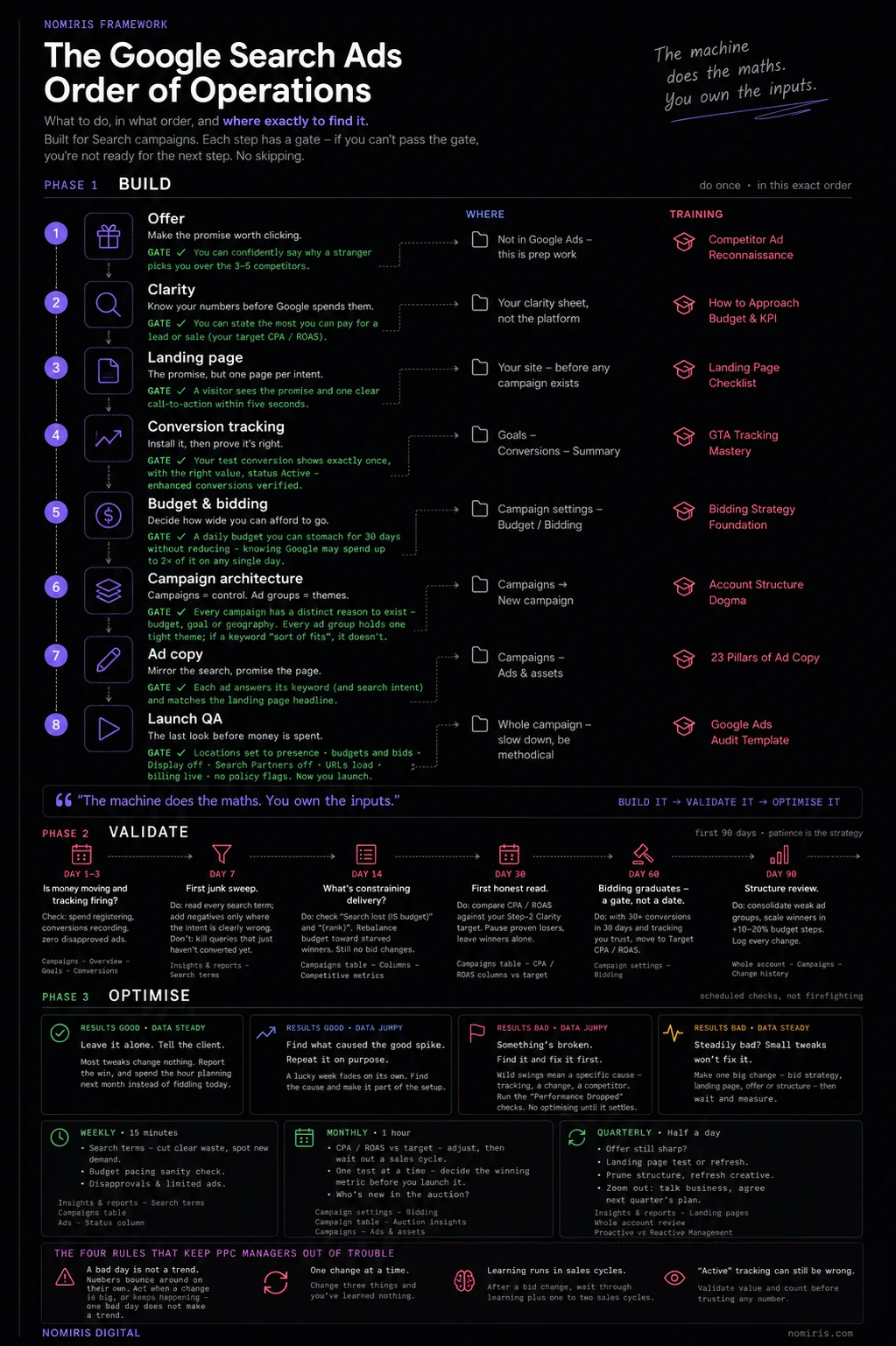
Phase 1: Build
Do once, in this exact order.
Build is the most underrated phase in PPC. Nobody talks about it because there is nothing to optimise yet. No dashboards. No metrics. Just decisions. But every disaster I have cleaned up traces back to something that was skipped in Build. The founder I just described is not unusual. I see some version of his story in almost every account I audit.
1. Offer
Make the promise worth clicking.
Before you touch Google Ads, you need an offer. Not a service description. Not a list of things you do. An offer. The specific promise someone gets by clicking your ad and doing business with you.
Most founders skip this completely. They open the platform and start typing keywords for their business category. "Digital marketing services." "AC repair." "Cardiologist in Mumbai." These are not offers. These are labels. A label tells people what you do. An offer tells them why they should care.
Where: Not in Google Ads. This is prep work. Sit with a notebook, a whiteboard, or your co-founder. Do not log into the platform.
Training: Competitor ad reconnaissance. Go to the Google Ads Transparency Center. Look at the ads your three to five closest competitors have been running longest. The ones still alive after months are the winners. Study their offer. Not to copy. To understand what the market responds to. Then build something sharper.
I did this exercise with the clinic in Mumbai. Their original offer was "Psychiatry Services in Mumbai." After studying competitors and thinking through what patients actually feared, they landed on: "Same-day psychiatry consultation. No waiting lists. Book by 2 PM, seen by 6 PM." Same doctors. Same clinic. Completely different promise. Their CTR went from 2.1% to 8.7%. Same budget. Almost 4x the traffic. Before a single keyword was changed.
Gate:
You can confidently say why a stranger picks you over the three to five competitors they are also considering. Not "we have great service." Not "we care about quality." Something a stranger would actually believe before they have met you. If you cannot clear this gate, nothing below matters.
2. Clarity
Know your numbers before Google spends them.
Google Ads is a math engine. If you feed it without knowing your own economics, you are gambling. The platform does not need you to have clarity. It will happily spend your money either way.
That founder spending ₹15 lakhs? He had never calculated his target CPA. He knew his margins. He knew his repeat purchase rate. What he had not done was connect those numbers to what a click could cost. He was bidding based on what Google suggested and what his agency recommended. Neither of those numbers came from his P&L.
His real cost per lead, once we isolated it, was ₹2,800. His service sold for ₹18,000 at roughly 35% margin after fulfilment costs. Meaning each customer was worth about ₹6,300 in contribution margin on the first sale. With his repeat purchase rate, lifetime value was higher. But on first sale alone, he needed leads below ₹2,200 to be comfortably profitable. He was ₹600 over that line on every lead. Volume was making the problem worse.
Clarity means translating your business economics into a single number: your target CPA or ROAS. Not a range. A ceiling. The number above which you are losing money on every acquisition. If you cannot state that number, Google is spending your money without a speed limit.
Where: Your clarity sheet. A spreadsheet. Not the platform. The platform tells you what happened after you spent. It does not tell you what you can afford.
Gate:
You can state the most you can pay for a lead or sale. Your target CPA or ROAS. Not a guess. Not a range. A number anchored to your margins, LTV, and payback window. If you have not calculated this, stop. Read the bidding strategy guide and come back.
3. Landing Page
The promise, built. One page per intent.
Your ad makes a promise. Your landing page keeps it. If those two things do not match, you are paying for clicks that will bounce.
A landing page at 10% conversion rate produces 3x more leads than one at 3%. Same traffic. Same spend. Triple the output. No bid strategy can compensate for a page that does not convert.
I once took over an account where the ads said "Free Google Ads Audit" but the page was the company's generic "Contact Us" form. The page asked for name, email, phone, company size, annual revenue, and preferred contact time. Seven fields. Zero mention of a free audit. The conversion rate was 0.4%. We built a single page with the headline "Get Your Free Google Ads Audit" and two fields: name and email. Conversion rate went to 6.1%. Same ad spend. Same keywords. Fifteen times the leads. The only thing that changed was the page.
Where: Your site. Before any campaign exists. The page must be live, loaded, and tested before you spend a single rupee.
Gate:
A visitor sees the promise and one clear call-to-action within five seconds. Not six. Not after scrolling. Five seconds, one CTA. If there are five things to click, there are zero things to click.
4. Conversion Tracking
Install it, then prove it is right.
If your conversions are not tracked properly, your entire Google Ads engine is running blind. Google cannot optimise. You cannot scale. You cannot troubleshoot. You cannot report ROI. This is not optional. This is oxygen.
I cannot count how many accounts I have opened where the tracking tag fires on page views instead of form submissions. Or fires twice per conversion. Or fires with no value. Or fires for the wrong action entirely. Every one of those accounts had an owner who thought tracking was "set up." Active is not the same as accurate.
Where: Goals, Conversions, Summary. Not a third-party dashboard. Not "the CRM says so." Google's own conversion report. That is the source of truth the algorithm reads from.
Gate:
Your test conversion shows exactly once. With the right value. Status: Active. Enhanced Conversions verified. Not "probably working." Not "looks right in preview." Confirmed with a live test before a single rupee of ad spend goes out. If this is shaky, fix conversion tracking first.
5. Budget & Bidding
Decide how wide you can afford to go.
Budget is not how much you want to spend. Budget is how much you can afford to lose while learning. Until the account has data, every rupee is tuition.
Set a number you can sustain for 30 days without reducing. Reducing budget mid-cycle resets learning, wastes data, and kills momentum. If you are not sure what number to set, start small. A campaign with a ₹500 daily budget that runs uninterrupted for 90 days will outperform a campaign that burns ₹2,000 a day for two weeks and then gets paused. Consistency beats intensity in paid search every single time.
Where: Campaign Settings, Budget and Bidding.
Gate:
A daily budget you can stomach for 30 days without reducing. Know that Google may spend up to 2x of it on any single day. If the thought of a double-spend day makes you panic, halve the number and double the timeline. Speed costs money. Patience costs time. Pick one.
6. Campaign Architecture
Campaigns equal control. Ad groups equal themes.
This is where most accounts die. Not from bad keywords. Not from weak bids. From structural chaos.
A clinic client of mine was running three campaigns that all targeted the same searches. None of them knew the others existed. Google's internal auction picked whichever had the highest bid, not the best match. People searching for "dental implants cost" were seeing his emergency dental ad and landing on a page about root canals. Bounce. Next search. Bounce. He was fighting himself and losing.
Each campaign must have a distinct reason to exist: budget, goal, or geography. Each ad group must hold one tight theme. If a keyword "sort of fits," it does not. The cost of cleaning structure later is ten times the cost of building it right the first time.
Where: Campaigns, New Campaign.
Gate:
Every campaign has a distinct reason to exist. Every ad group holds one tight theme. You can explain the purpose of each in one sentence. If you cannot, the structure is wrong. Read the keyword detox guide to understand what happens when you skip this.
7. Ad Copy
Mirror the search. Promise the page.
Bad keywords plus good ad copy equals wasted spend. Good keywords plus bad ad copy equals wasted spend. Both must work.
The ad must answer the search query and pre-qualify the click. Use pricing, location, and credibility signals to filter out the wrong traffic before they cost you money. Pin headlines that do the filtering for you.
Where: Campaigns, Ads and Assets.
Gate:
Each ad answers its keyword and search intent, and matches the landing page headline. The searcher reads the ad, clicks, and lands on a page that feels like the natural next sentence. Not a different conversation.
8. Launch QA
The last look before money is spent.
Slow down. Be methodical. The campaign will still be there in twenty minutes. Go through every setting one by one. The things that break campaigns are never complicated. They are small, stupid, and obvious in hindsight.
I once launched a campaign for a client and accidentally left Search Partners on. The client's budget was ₹30,000 a month and Search Partners chewed through ₹12,000 of it in two weeks on garbage placements. One checkbox. ₹12,000. That is what QA is for.
Gate:
Locations set to Presence, not "Interest in". Budgets and bids correct. Display Network off. Search Partners off. All URLs load and resolve. Billing is live. Zero policy flags. Now you launch.
"The machine does the maths. You own the inputs."
Build it, then Validate it, then Optimise it. In that order. Always.
Phase 2: Validate
First 90 days. Patience is the strategy.
This is the phase that separates professionals from gamblers. Here is what usually happens: someone launches on Monday. By Wednesday they are tweaking bids. By Friday they have changed the ad copy twice. By Sunday the campaign is paused and they are telling people "Google Ads doesn't work."
What they actually did was launch a campaign and then strangle it before it could breathe. Google's learning phase needs time. Not opinions. Not instincts. Time.
The dates below tell you when to look. The data tells you whether to act. These are not the same thing. Most checks below tell you to do nothing. That is the point. The hardest skill in Google Ads is knowing when not to touch anything.
Day 1 to 3: Is money moving and tracking firing?
Check:
- Spend registering
- Conversions recording
- Zero disapproved ads
Touch nothing else. Not bids. Not keywords. Not ad copy. If spend shows but conversions do not, that is the only problem you fix. Everything else waits.
A campaign I audited last year had zero conversions on Day 2. The team running it raised bids by 40% to "force delivery." The tracking tag was broken. Nobody checked because the dashboard showed spend and impressions, which looked alive. The tag was installed on the wrong page. For two days they paid a premium for clicks that could never fire a conversion. The fix took five minutes. The overpay was ₹3,200. Check tracking first. Always.
Day 7: First junk sweep
Do:
- Read every search term.
- Add negatives only where the intent is clearly wrong.
Do not:
- Kill queries that just have not converted yet. Low volume is not a crime.
- Touch bids. Seven days of data is noise, not signal.
The temptation here is to kill everything that has not converted. Resist it. A search term with 30 impressions and no conversions is not a loser. It is a term that has been seen 30 times. That is nothing.
Day 14: What is constraining delivery?
Do:
- Check Search Lost IS (Budget) and Search Lost IS (Rank).
- Rebalance budget toward starved winners.
Still no bid changes. Two weeks of data is slightly less noisy noise. Still noise.
Day 30: First honest read
Thirty days. This is the first moment data deserves your attention. Not before.
Do:
- Compare CPA or ROAS against your Step 2 Clarity target.
- Pause proven losers. Campaigns or ad groups that have spent meaningfully and produced nothing. Be honest: "it might work next week" has killed more budgets than bad ads ever did.
- Leave winners alone. Do not "improve" things that are already working.
- Keep collecting clean conversions. The data is still building.
Track micro-conversions as secondary conversions only. Form starts, time on page, scroll depth. These are diagnostic signals. They are not results. Never use them as a substitute for primary conversions. I have seen agencies report "engagement conversions" to clients when real leads were down. That is not reporting. That is lying with extra columns.
Day 60: Bidding graduates
This is a gate, not a date. Do not switch to automated bidding just because the calendar says Day 60. Switch because the conditions are met.
Condition: thirty or more conversions in thirty days AND reliable tracking.
If yes: move to Target CPA or Target ROAS using your actual thirty-day averages as the starting target. Not your aspirational target. Your actuals. Give the algorithm a number it has already seen. Let it learn from reality before you ask it to improve.
If no: stay manual. Keep collecting clean data. Automation without data is guessing with your money.
Judge tROAS only after meaningful conversion volume. ROAS on twelve conversions is a rounding error dressed as a strategy.
Day 90: Structure review
Do:
- Consolidate weak ad groups. If two ad groups serve the same intent and one never performs, merge them. Simpler structure means more data per ad group, which means faster learning.
- Scale winners in ten to twenty percent budget steps. Not fifty percent. Not double. The algorithm needs time to adapt to each increase.
- Log every change. Date. What you changed. Why. What you expect to happen. What actually happened fourteen days later. Without a log, you will make the same mistake twice and wonder why.
Phase 3: Optimise
Scheduled checks. Not firefighting.
Optimisation is not a daily activity. It is a scheduled discipline. Tweaking starts from week two onwards, and only when you can see a real change, not a wobble, not a daily fluctuation. If you cannot see a real change, do not act. Most tweaks change nothing. The ones that do change things usually make them worse before they make them better.
There is a type of PPC manager I call the "fidgeter." They open the dashboard every morning, see a number they do not like, and change something. By the end of the month they have made forty changes and have no idea which one mattered. Their accounts underperform everyone else's because the algorithm never gets a full learning cycle. They are not optimising. They are interrupting.
Results Good + Data Steady
Leave it alone. Tell the client. Most tweaks change nothing.
Report the win and spend the hour planning next month instead of fiddling today. Fiddling with a winning campaign is like rearranging furniture in a house that is not on fire. You are not fixing anything. You are just uncomfortable with things going well.
Results Good + Data Jumpy
Find what caused the spike. Repeat it on purpose.
A lucky week fades on its own. If you do not isolate the cause, a seasonal shift, a competitor pausing, a news event driving search volume, you will chase the high forever and never catch it.
Find the cause. Make it part of the setup. If you cannot find the cause, accept it was luck and move on. Do not "optimise" toward a one-week outlier.
Results Bad + Data Jumpy
Something is broken. Find it and fix it first.
Wild swings mean tracking is malfunctioning, a competitor entered or exited aggressively, site changes broke the conversion path, or seasonal demand shifted. Run the "Performance Dropped" checklist. Do not optimise until it settles. Tweaking a broken system makes the break harder to find.
Results Bad + Data Steady
Small tweaks will not fix this. The data is telling you something fundamental is wrong.
Make one big change: bid strategy, landing page, offer, or campaign structure. One change. Then wait and measure through a full sales cycle. Do not make a second change before the first one has shown its result. The serial killer of campaigns is impatience disguised as "optimisation."
The Rhythms: Weekly, Monthly, Quarterly
Optimisation is not about how often you open the dashboard. It is about what you do when you open it.
Weekly (15 Minutes)
- Search terms. Remove waste. Find demand you did not know existed. This is the single highest-ROI fifteen minutes in PPC. Read the match types guide if you are unsure what to add as negative.
- Budget pacing. Are you on track or burning too fast? A campaign that spends its daily budget by 11 AM is not "performing well." It is unmanaged.
- Disapprovals and limited ads. Fix immediately. A disapproved ad is a paused ad you are not aware of.
Monthly (1 Hour)
- CPA or ROAS versus target. Not versus last month. Versus the target you set in Step 2. Are you getting closer or further?
- Adjust and wait. Any change you make now needs a full sales cycle before you judge it.
- One test at a time. One ad copy test. One landing page variant. One audience exclusion. Run it, wait, measure, decide. Then start the next one.
- Review Auction Insights. Who entered? Who left? Who is outbidding you? The auction is a living thing. Check what is new since last month.
Quarterly (Half a Day)
- Is the offer still sharp? Markets shift. Competitors catch up. What was compelling in January might be generic by April.
- Landing page test or refresh. Your page has been running for ninety days. Test a variant. Even a one percent conversion rate improvement compounds across every click.
- Prune campaign structure. Consolidate what is redundant. Kill what is dead. The account should get simpler over time, not more complex.
- Refresh creatives. Ad fatigue is real. Even responsive search ads benefit from fresh assets.
- Zoom out with the business. Are you still solving the right problem? Has the business priority shifted? The best Google Ads account optimised for last quarter's goal is a liability.
- Agree next quarter's plan. Not with Google. With the business. The next quarter's priorities, budget, and offers should come from where the company is going, not where the last ninety days went.
The Four Rules That Keep You Out of Trouble
I learned these the hard way. Every single one comes from a mistake I made with real money.
1. A bad day is not a trend.
Numbers bounce around naturally. Monday was bad. So what? Look at seven-day and thirty-day rolling averages. Act only when a change is significant AND persistent. A single bad day is weather. A bad fortnight is climate. Only one of those deserves your attention.
I once killed a campaign because it had a terrible Tuesday. The Monday had been fine. The Wednesday was fine. I reacted to a single data point and threw away a campaign that went on to perform at 2.3x ROAS for the client who replaced me.
2. One change at a time.
Change multiple things and you will never know what caused the result. Was it the bid increase or the new headline? Was it the audience exclusion or the landing page tweak? You will never know. And you will make the same mistake again because you never isolated what worked or failed.
3. Learning runs in sales cycles.
After any bid change, wait through the learning period plus one or two sales cycles. If your sales cycle is twenty-one days, do not judge a bid strategy change on Day 10. The data you are looking at has not happened yet. This single rule would save most advertisers thirty percent of their wasted spend.
4. Active tracking can still be wrong.
Validate every conversion before trusting the numbers. A green "Active" badge in the conversion column means the tag fires. It does not mean the tag fires correctly. It does not mean the value is right. It does not mean duplicates are handled. Test with a real conversion. Every time. Before you spend. Before you scale. Before you report.
That founder who was barely breaking even? We did not fix one thing. We rebuilt the foundation in order. Offer first. Landing page. Tracking validated. Clarity on numbers. Then campaign structure. Then ad copy. Then launch.
Within ninety days his cost per lead was below ₹2,100. The margin per customer flipped from break-even to profitable. Revenue grew because he could finally scale spend without the math getting worse. The machine was no longer consuming cash to stay alive. It was compounding.
Individual results vary. These figures are from one specific client engagement and should not be taken as a guarantee of your own outcomes.
He still runs the account. He spends about four hours a month on it. He told me last quarter was his best ever.
The sequence is the strategy.
Bottom Line
Patience is not passive.
Fix broken tracking, wrong locations, and policy errors immediately. These are not optimisations. They are repairs. Repairs do not wait for a sales cycle.
Delay unnecessary tinkering. If the numbers are within range and the trend is flat or up, do nothing. The best PPC managers I know spend more time not touching accounts than touching them. Their accounts outperform everyone else's.
Prioritise repairs over refinements. A campaign with bad location targeting but perfectly optimised bids is still showing ads to the wrong people. Fix the structure. Then let the data tell you what to do next.
The machine does the maths. You own the inputs. Build it right. Validate it patiently. Optimise it sparingly.
That is the entire game.
Let Us Find the Gaps in Your Lead Acquisition.
Is marketing complexity slowing down your practice?
If managing your growth feels overwhelming, you don't need another tool - you need a partner. We help medical practices and wellness businesses handle their end-to-end digital infrastructure.
We will deep-dive into your website and funnel to understand exactly where the problem is. Our team fixes the gaps in your positioning and deploys the Nomiris P2P Acquisition System to generate insane ROI:
- Complete Branding, Strategy & Gap Analysis
- High-Converting Landing Pages
- End-to-End Ad Management
- Lead Recovery & Nurturing
- ROI & Attribution Tracking
If you want to stop guessing and start scaling with a data-driven infrastructure, let’s connect.

Hemanth M Reddy
Author
End-to-End Performance Marketing Specialist. I don't just 'run ads'; I fix the foundation. From correcting broken conversion tracking to integrating CRMs, I ensure you own your data and stop wasting budget on ghost leads.