Table of Contents
8 sections
Google Ads Bidding Strategy: How to Set Bids That Actually Make Sense
 Hemanth M Reddy
 ChatGPT
Bidding is a balancing act, not a repair tool. Fix tracking, structure, and conversion rate first. Then let LTV, margins, and conversion rates tell you what a click is actually worth.
You've set up campaigns. You've written decent ads. Your keywords are reasonably tight. But when it comes to bidding, you're still doing some version of "pick a number and hope."
Maybe you've toggled between Manual CPC and Target CPA three times this quarter. Maybe you set a bid once, saw costs creep up, panicked, and dropped it, only to watch impressions vanish. Or maybe you've left Google's automated bidding on and quietly wondered whether it's spending your budget wisely or just spending it.
Here is the thing most guides will not say upfront: your bid strategy cannot fix a broken account. If your keywords are scattered, your ad copy does not match your landing page, or you are not tracking conversions properly, no amount of bid tweaking will save you. Bidding is a lever, but it only works when the machine it is attached to is built right.
This article gives you a concrete framework for setting starting bids, whether you are launching a new campaign or inheriting an existing account. We are going to calculate what you should be bidding from actual business math, decide when manual versus automated makes sense, and separate real bidding problems from account problems pretending to be bidding problems.
The job of bidding is not to rescue the account. It is to balance economics and outcomes.
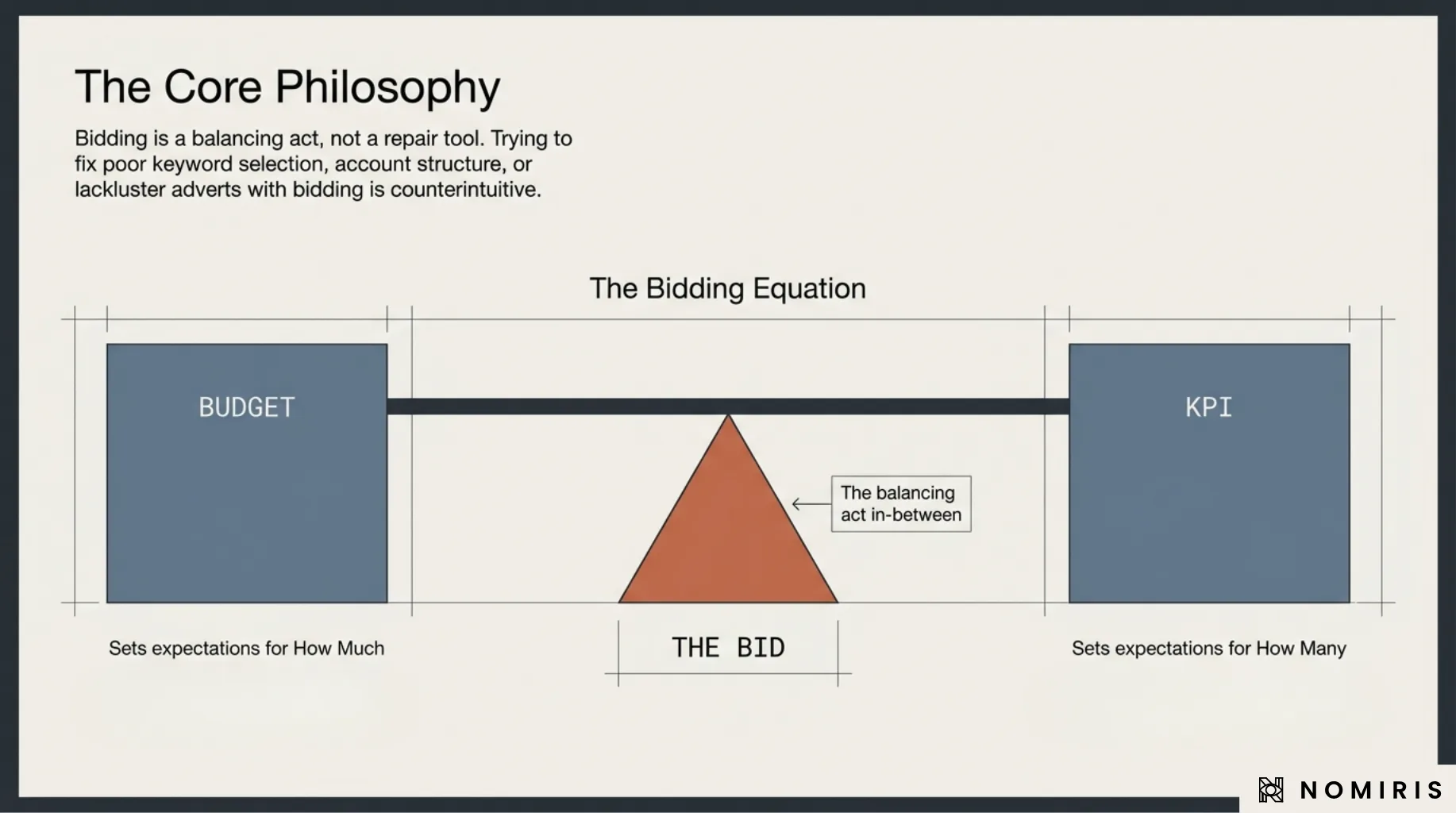
Budget and KPI create the constraints. The bid is the balancing act in the middle.
Before You Touch Bids: The Checklist Nobody Wants to Hear
This is the unsexy part. It is also the part most people skip, which is exactly why their bidding strategy underperforms.
Before bidding can do meaningful work, these things need to be true:
- Your conversion tracking is accurate and firing correctly. Not "probably working" but verified. If your automated bid strategy is optimising toward broken data, it is optimising toward garbage. Check the setup, confirm conversions are deduped, and make sure you are tracking the action that actually matters to the business. If this is shaky, fix conversion tracking first.
- Your account structure is sound. Campaigns should be built around clear themes. Ad groups should be tight. If a single ad group contains "cheap running shoes" and "best marathon trainers," your ads cannot speak to both, and your bids end up fighting themselves.
- Your keywords and match types make sense. Search term reports should show queries you would actually want to pay for. If not, the issue is match types or negatives, not bidding.
- Your ad copy matches the searcher's intent. Weak message match destroys conversion rate, which makes every bid more expensive in practice no matter what number you set.
- Your landing page converts. A 1% conversion rate versus a 4% conversion rate means your effective acquisition cost is 4x higher. No bid strategy compensates for that.
If any of those are broken, fix them first. Bidding is the adjustment layer on top of a functioning system. It is not the system.
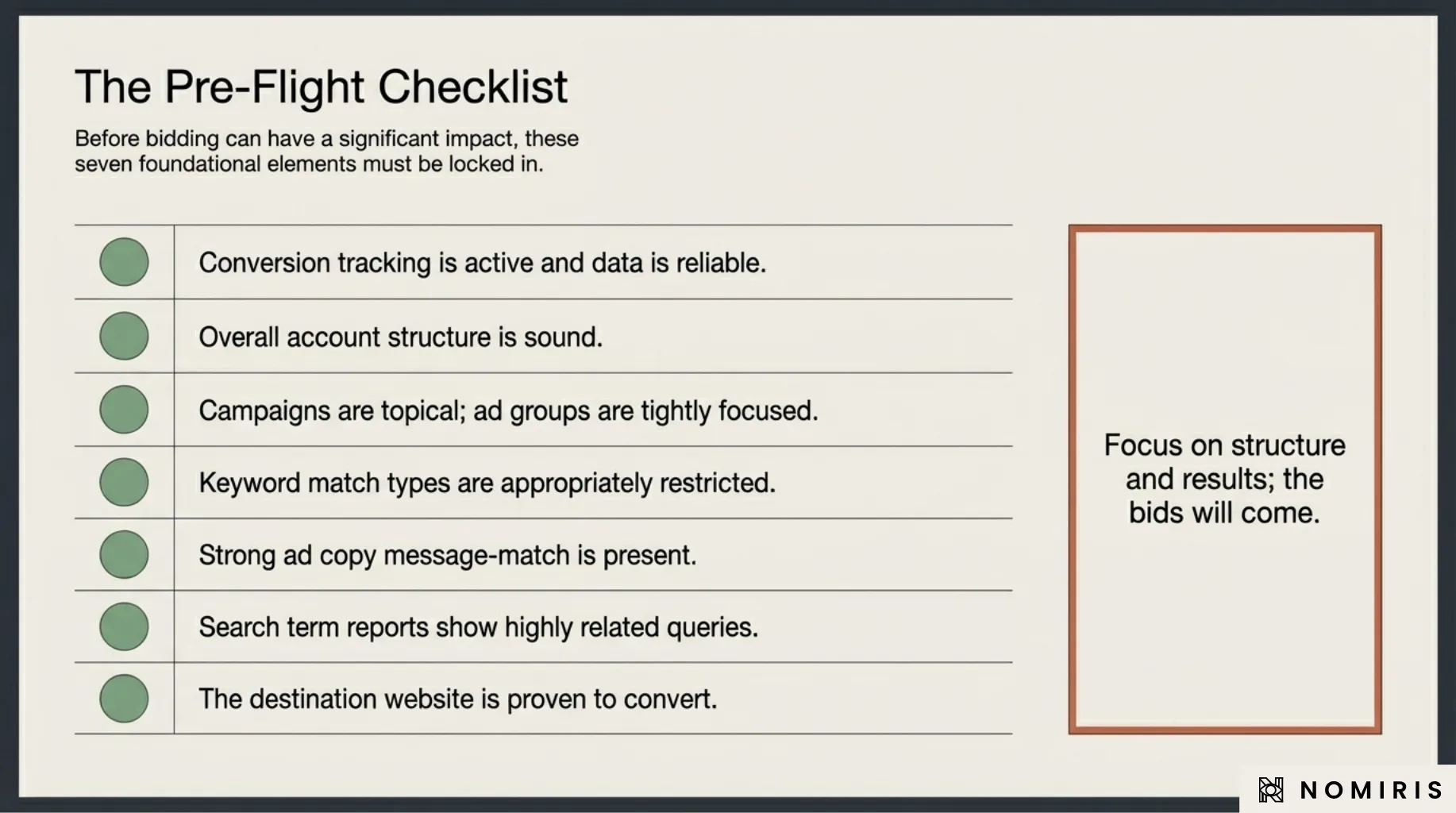
Focus on structure and results first. The bids come after.
How to Calculate Your Starting Bid (With Real Numbers)
Here is where most guides say something useless like "set a bid you are comfortable with." That is not a strategy.
Your starting bid is the maximum you should pay per click at your current conversion rate while still protecting margin. To find it, you need three numbers: customer lifetime value, website conversion rate, and for lead generation, your lead-to-sale rate.
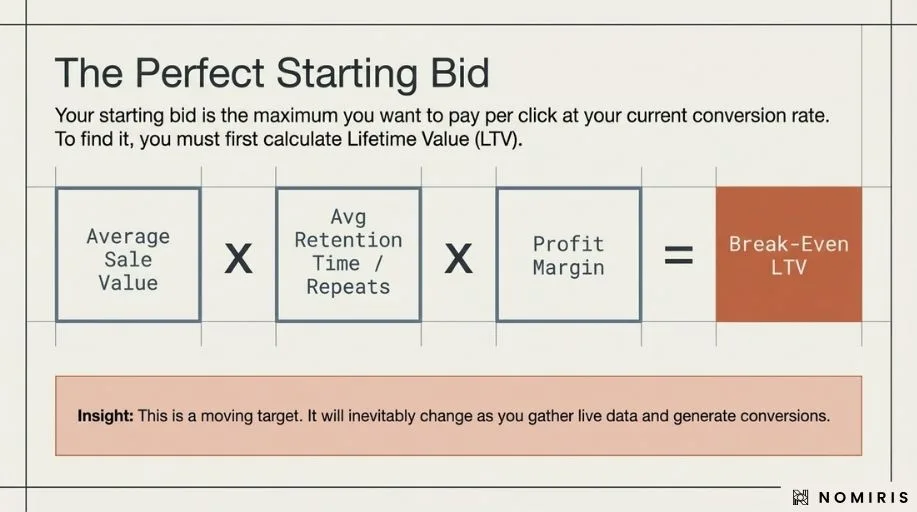
Every sensible bid starts with value. If you do not know LTV, you do not know what a click is worth.
Step 1: Calculate Lifetime Value (LTV)
The baseline formula is straightforward:
Average sale value × average retention or repeat purchase rate × profit margin = break-even LTV.
| Example | Calculation | Break-even LTV |
|---|---|---|
| Insurance company | ₹37,500 × 1.5 years × 50% | ₹28,125 |
| E-commerce retailer | (₹2,500 × 1.33 repeats × 40%) − 2% returns | ₹1,304 |
That number is your ceiling for profitable acquisition. Not your bid yet, but the raw business value you are working from.
Step 2: Turn LTV Into a Real Bid Ceiling
Now you connect business value to paid traffic economics.
For lead generation, do not jump straight from sale LTV to bidding. First translate sale value into lead value:
Lead value = LTV × lead-to-sale rate.
Then turn that into a manual CPC ceiling:
Max CPC = lead value × website conversion rate.
Using the insurer example:
- Sale LTV = ₹28,125
- Lead-to-sale rate = 20%
- Lead value = ₹5,625
- Website conversion rate = 5%
- Break-even max CPC = ₹281
If you are using Target CPA on the lead action, your CPA target must sit below that ₹5,625 lead value. The visual framework below is useful as a shorthand, but the real rule is simple: your automation target must come from unit economics, not guesswork.
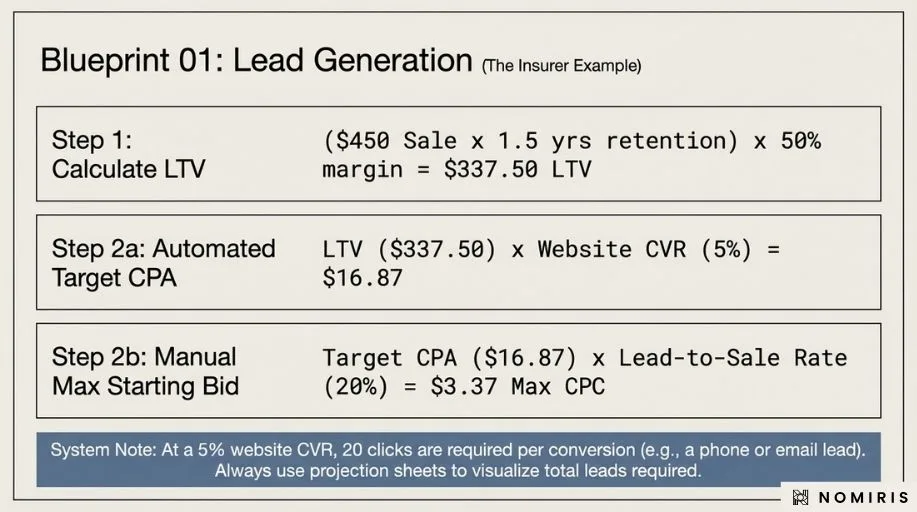
For lead gen, translate sale value into lead value first. Then let website conversion rate tell you what a click can cost.
For e-commerce, you do not need a lead-to-sale adjustment, but you do need to respect return rates and the minimum profitable ROAS.
- Break-even LTV = ₹1,304
- Break-even ROAS threshold = 3.26x
- If the store converts at roughly 8%, that supports a starting max CPC of about ₹104
That means a Target ROAS strategy should be held above the 3.26x break-even line, and manual bidding should stay anchored to the CPC ceiling your store economics can carry.
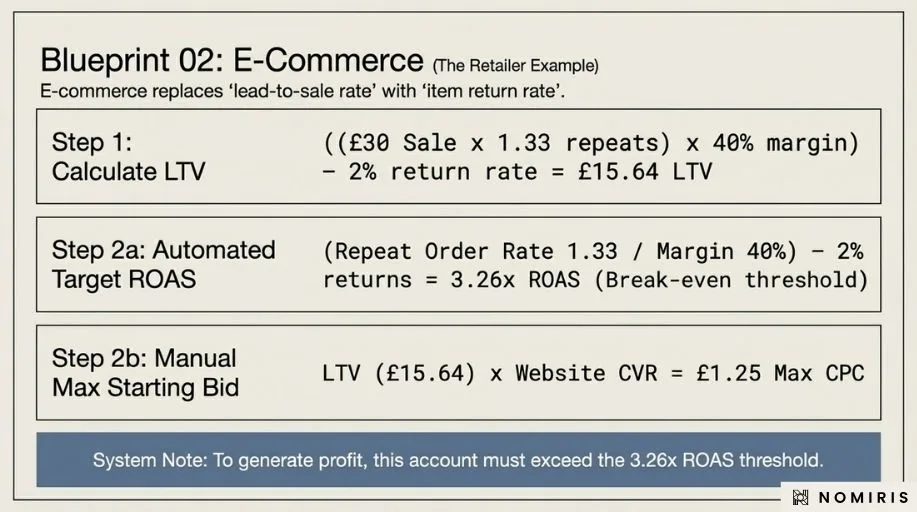
E-commerce replaces lead-to-sale rate with repeat order behaviour, returns, and ROAS discipline.
Step 3: Estimate Clicks to Convert
If you are not sure what paid-search conversion rate to use, start with your organic traffic as a baseline. In well-structured accounts, paid search usually matches or outperforms organic because the traffic is more intentional and you control the landing experience.
The math is simple:
100 ÷ conversion rate = clicks needed per conversion.
At a 7% conversion rate, that is about 14.29 clicks. Multiply that by your expected CPC from Keyword Planner or your forecast sheet, and you have your estimated cost per conversion.
If that estimated cost per conversion is below your allowable CPA or below the value implied by your LTV math, you have a viable campaign. If it is above, you do not have a bidding problem. You have a conversion-rate problem, a keyword-cost problem, or a payback-window decision to make.
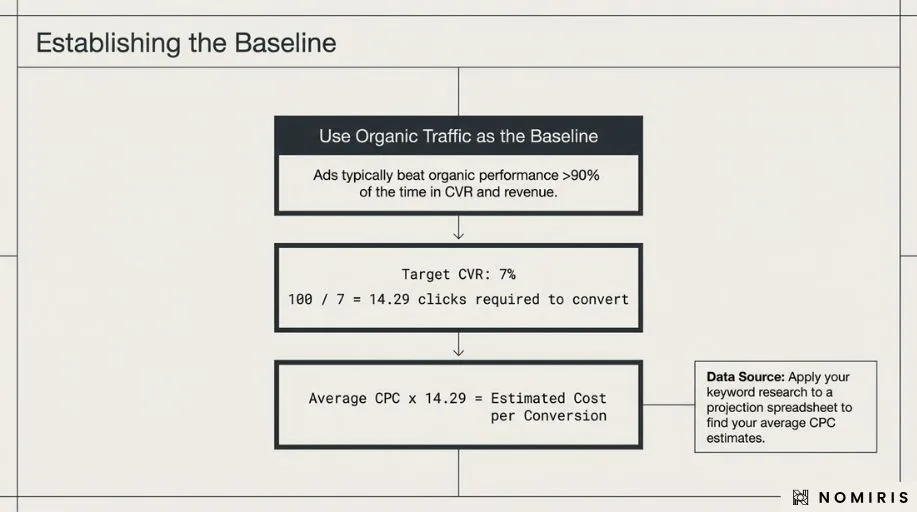
Use organic as the baseline when paid data is thin. Then pressure-test the numbers against your CPC forecasts.
Manual vs. Automated: When to Use Which
This is where marketers get tribal. Some swear by manual control. Others trust Google's machine learning completely. The practical answer depends on one thing: how much reliable conversion data you actually have.
New accounts with no trustworthy data: start manual
Google's automated strategies need data to optimise against. Without it, the algorithm is guessing, and it is guessing with your money. Manual CPC gives you tight spend control while the account builds signal.
The goal is not perfection. The goal is learning. Get conversions flowing, confirm tracking is solid, and gather enough clean data for automation to work with.
The Enhanced CPC trap
Enhanced CPC sounds like a safe middle ground, but it is easy to misunderstand. Once enabled, Google can push your average CPC above the max CPC you set. Many marketers switch it on without realising their "manual" setup is no longer fully manual. Test it only after your baseline is stable, and watch actual CPCs closely.
When automation genuinely wins
Once you have consistent conversion volume, usually at least 15 to 30 conversions per month and preferably more, strategies like Target CPA or Target ROAS tend to outperform manual bidding. The system can process signals you cannot realistically manage at scale: device, location, time of day, audience, and query context.
The mistake is not automation. The mistake is feeding automation the wrong target. If your CPA or ROAS target is not grounded in business reality, the algorithm will still chase it faithfully and you still will not be profitable.
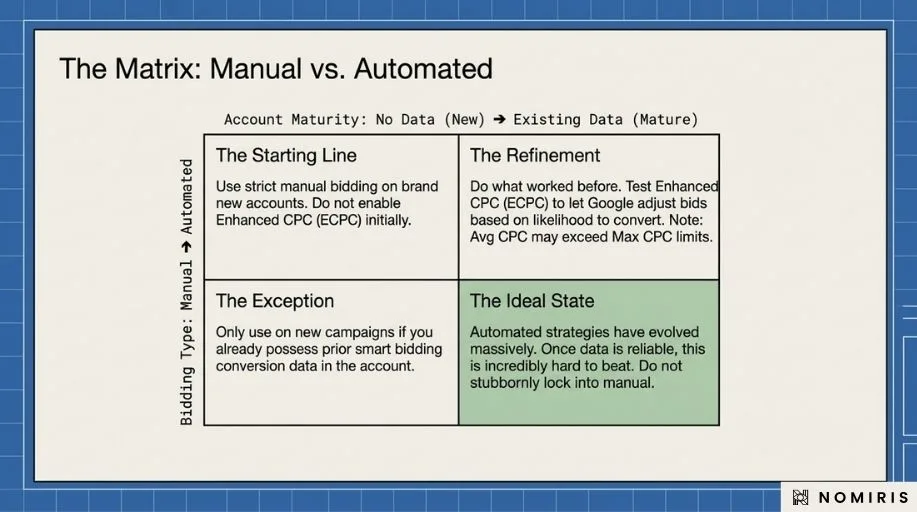
Manual is for learning. Automation is for scaling. Enhanced CPC sits in the middle and needs supervision.
If frameworks like this are useful to you, keep going through the Google Ads archive. The useful stuff is never just "which button to click." It is how the economics, tracking, and structure fit together.
Where Bidding Gets Genuinely Complex
Everything above gives you a solid starting point. But bidding has layers that only show up once the fundamentals are in place.
Auction dynamics are not static
Your bid does not exist in isolation. It competes in a live auction against other advertisers, and that environment changes constantly. A bid that was profitable last Tuesday can become unprofitable this Tuesday because a competitor raised budget or a new advertiser entered the auction. This is why bidding cannot be a "set it and revisit next month" task in competitive verticals.
Quality Score is the silent multiplier
Google does not simply reward the highest bidder. Expected click-through rate, ad relevance, and landing-page experience all shape ad rank and effective CPC. Two advertisers can bid the same amount and pay very different prices. Improving Quality Score is often the highest-leverage move you can make, and it is usually a structure-and-message problem, not a bid-number problem. If you want a deeper look, read how Quality Score changes your Google Ads costs.
Negative keyword strategy gets harder at scale
In a small account, checking search terms once a week is manageable. At scale, negative keyword management becomes a discipline of its own. Poor negative hygiene makes your bids pay for irrelevant clicks, which inflates CPA without any change in your bid settings. The symptoms look like a bidding issue. They are not. If you want to tighten this part of the machine, start with keyword detox and match types.
Attribution is murkier than it looks
Which click should get credit for the conversion? First click? Last click? The click from three days ago on another device? Your bid strategy optimises toward whichever attribution model you have chosen, and different models will tell you very different stories about which campaigns are working. Once the account has meaningful volume, attribution deserves its own serious review because it directly shapes how automation spends.
What You've Got, and What Comes Next
You now have the part most advertisers skip: a defensible starting framework.
You know bidding only works when the fundamentals underneath it are sound. You know how to calculate a sensible starting bid from LTV, conversion rate, and margin instead of instinct. You know when to go manual, when automation has earned the right to take over, and why Enhanced CPC is not the harmless middle ground it looks like.
Most importantly, you know that the real complexity in bidding lives beyond the bid box itself. It lives in auction pressure, Quality Score, negative keywords, landing-page performance, and attribution.
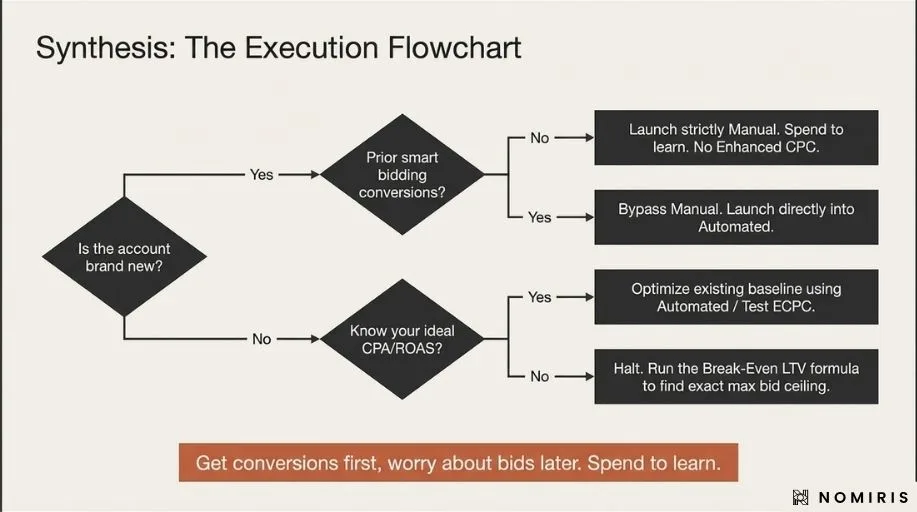
Get conversions first. Worry about bid sophistication after the account has earned it.
If you want to keep sharpening this kind of thinking, read conversion tracking next, then go deeper on costs and Quality Score. That is the right order.
Let Us Find the Gaps in Your Lead Acquisition.
Is marketing complexity slowing down your practice?
If managing your growth feels overwhelming, you don't need another tool - you need a partner. We help medical practices and wellness businesses handle their end-to-end digital infrastructure.
We will deep-dive into your website and funnel to understand exactly where the problem is. Our team fixes the gaps in your positioning and deploys the Nomiris P2P Acquisition System to generate insane ROI:
- Complete Branding, Strategy & Gap Analysis
- High-Converting Landing Pages
- End-to-End Ad Management
- Lead Recovery & Nurturing
- ROI & Attribution Tracking
If you want to stop guessing and start scaling with a data-driven infrastructure, let’s connect.

Hemanth M Reddy
Author
End-to-End Performance Marketing Specialist. I don't just 'run ads'; I fix the foundation. From correcting broken conversion tracking to integrating CRMs, I ensure you own your data and stop wasting budget on ghost leads.